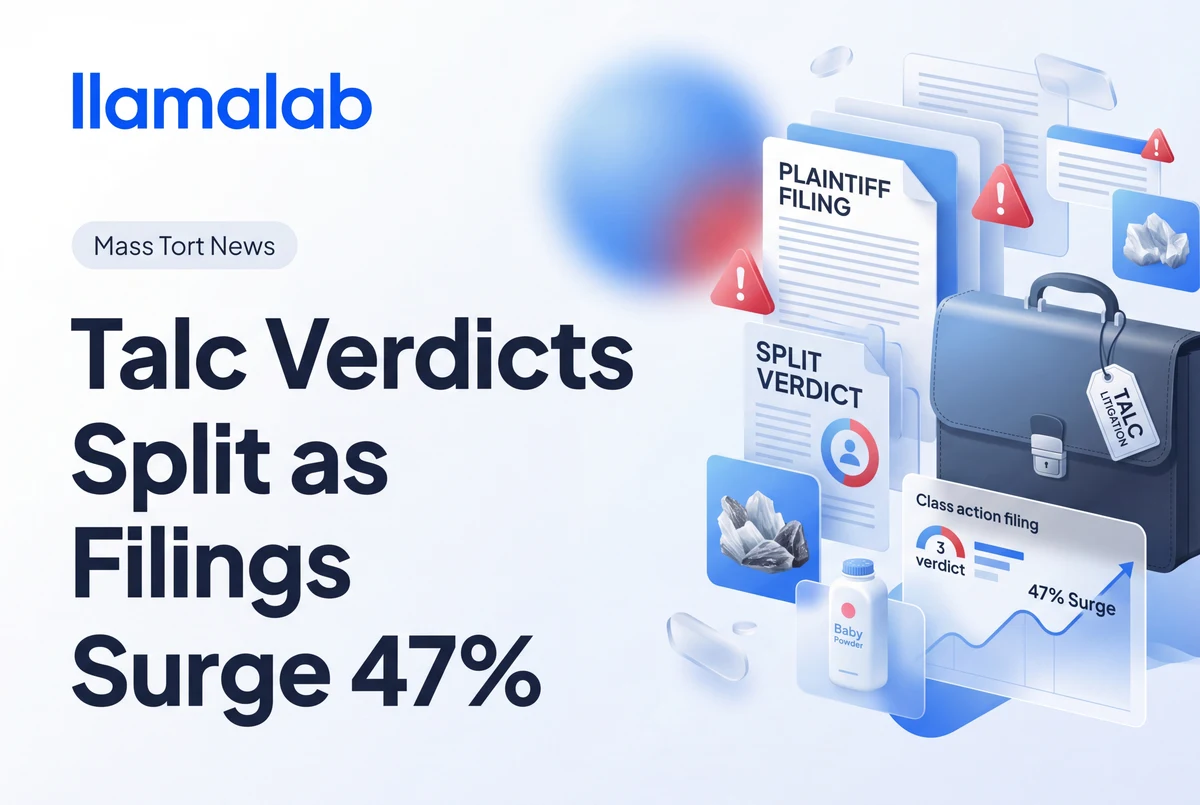
Talc Verdicts Split as Filings Surge 47% in 2025

CEO & Founder at LlamaLab
Talc Verdicts Split Wide as Filings Surge 47%
Talc litigation generated contrasting trial outcomes in late May 2026. A Minnesota jury awarded $10.2 million on May 15, 2026 to a couple alleging asbestos-contaminated cosmetic talc caused malignant pleural mesothelioma, Law.com reported. Days later, Johnson & Johnson secured a defense verdict in an Oklahoma County mesothelioma trial and saw a 2021 defense judgment affirmed by the Pennsylvania Superior Court, Law.com reported on May 29.
These divergent outcomes occur alongside rising filing volumes. Talc-only lawsuits increased 47% in 2025, according to KCIC's 2025 Asbestos Litigation Year in Review, released in April 2026 and analyzed by Asbestos.com. The variance across jurisdictions highlights how case outcomes turn on documented lifetime exposure histories and objective pathology.
Single-year increase in talc-only filings in 2025 (KCIC Annual Report)
Share of 2025 mesothelioma filings including a talc claim, up from 16% in 2019
Plaintiff win rate in talc-asbestos trials over the prior 5 years (KCIC)
Recent Verdicts Across Mesothelioma Dockets
The Minnesota action illustrates how talc liability encompasses multiple supply chain entities. The jury found five manufacturers liable for design and marketing defects, apportioning liability among Vi-Jon (supplier of private-label store brands for national retailers), Gold Bond, Merck's Dr. Scholl's line, Johnson & Johnson, and Perrigo, Asbestos.com reported.
Concurrently, an Oklahoma County jury returned a defense verdict for Johnson & Johnson following trial, while the Pennsylvania Superior Court affirmed an earlier defense verdict in an ovarian cancer matter, Law.com reported.
Talc Trial Outcomes, May 2026
| Case / Venue | Injury Type | Outcome |
|---|---|---|
| Heyer (Minnesota) | Mesothelioma | $10.2M plaintiff verdict across 5 defendants |
| Passmore-Meyer (Oklahoma) | Mesothelioma | Defense verdict for Johnson & Johnson |
| Philadelphia (Pa. Superior Court) | Ovarian cancer | 2021 defense verdict affirmed |
| Los Angeles Coordinated Bellwether | Ovarian cancer | $40M plaintiff verdict (Dec. 2025) |
This is an important statement in Minnesota against companies that take our neighbors' health lightly.
Chad AlexanderCo-counsel for the Heyers
Shifts in Asbestos Litigation Demographics
The demographic profile of asbestos litigation continues to evolve. Talc claims now account for 40% of all filed mesothelioma actions nationally, up from 16% in 2019, according to KCIC data.
The plaintiff population has shifted accordingly. While traditional industrial asbestos claims involved predominantly male occupational cohorts, 57% of talc-only claimants are women, reflecting long-term consumer cosmetic powder usage. Talc-only complaints are concentrated in malignant mesothelioma, which accounts for 95.5% of non-ovarian filings in the category.
Mesothelioma Share
Talc claims grew from 16% of mesothelioma filings in 2019 to 40% in 2025 (KCIC)
Female Claimants
Share of women among talc plaintiffs, compared to 18% in traditional industrial asbestos claims
Mesothelioma Focus
Proportion of talc-only filings involving mesothelioma diagnoses (KCIC)
The Role of Exposure Chronologies
Clinical Documentation Demands
Talc actions require extensive multi-decade medical histories:
- Pathology and Biopsy Records: Confirmatory immunohistochemistry staining distinguishing mesothelioma subtypes (epithelioid, sarcomatoid, biphasic) from adenocarcinoma.
- Longitudinal Medical Histories: Primary care, pulmonology, and thoracic surgery notes documenting symptom progression and initial presentation.
- Product Identification Evidence: Purchase records, household usage logs, and witness testimony establishing specific brand exposures across decades.
- Occupational and Secondary Records: Employment records rule out non-talc occupational amphibole exposures.
- Multi-Jurisdictional Records: Care histories distributed across multiple regional hospital systems and legacy facilities.
Reverse search uses insurance data to fill in treatment gaps clients don't always remember, surfacing facilities, dates, and clinicians as needed.
Strategic Implications for Law Firms
With filings increasing and California state bellwethers continuing following a $40 million verdict in late 2025, litigation practices are focusing on four operational priorities:
- Intake Screening: Verifying continuous usage histories and diagnostic pathology before filing.
- Multi-Manufacturer Attribution: Documenting exposure across brand names and private-label retailers.
- Alternative-Cause Analysis: Documenting occupational histories to address alternate fiber exposure defenses.
- Complete Medical Chronologies: Assembling complete diagnostic, surgical, and oncology records from every treating provider.
Evidentiary Demands in Active Talc Litigation
Recent split verdicts reflect the evidentiary demands of talc litigation. Outcome variance is driven by the depth and completeness of the claimant's underlying clinical and exposure record.
Firms managing talc inventories require systematic retrieval infrastructure to locate treating facilities, retrieve archived charts, and verify diagnostic pathology.
Records generally return in 4 days on average, with roughly 30-40% returned same-day on electronic requests. Because medical record retrieval is an itemized case disbursement, invoices flow directly onto settlement statements.
Build Verified Talc Case Files
LlamaLab retrieves multi-decade medical records, oncology files, and pathology reports in 4 days on average. Verify brand histories and treatment timelines across your inventory.
This article is for informational purposes only and does not constitute legal or medical advice. Sources: Law.com (May 21), Law.com (May 29), Asbestos.com (May 13), Asbestos.com (May 26), Sokolove Law, PRNewswire / KCIC.
Stay Updated with Latest Insights
Get the latest articles about medical record retrieval and legal tech delivered to your inbox.