Hernia Mesh Lawsuit Average Payout: Bard Settlement Update

CEO & Founder at LlamaLab
Bard Hernia Mesh Settlement Update: Average Payout, Case Counts, and the 2027 Settlement Process
Updated September 29, 2026: Case counts now come from the JPML's September 1, 2026 report and BD's June 2026 quarterly filing, and a new section covers what is known about average payouts. Payout tier figures that no court order or BD filing supports have been removed or labeled as law-firm reports, and fund administration details now follow the court's order.
Becton Dickinson announced on October 2, 2024 that it had agreed to resolve the "vast majority" of its hernia mesh lawsuits, and people familiar with the deal told Bloomberg that BD will pay more than $1 billion to resolve more than 38,000 lawsuits. Two years later, no average payout has been published. BD called the settlement confidential, and an October 2025 order in MDL 2846 says individual settlement amounts "are confidential and shall not be disclosed unless the Court requests." What a claimant receives depends on the medical record behind the claim.
The federal docket is still large. The Judicial Panel on Multidistrict Litigation's September 1, 2026 report lists 23,316 cases pending in MDL 2846 before Judge Edmund A. Sargus, Jr. in the Southern District of Ohio, second only to the Johnson & Johnson talc MDL. BD's own count is much smaller. In its quarterly report for the period ended June 30, 2026, the company said it was defending about 7,090 hernia repair claims in all courts and that "there are no trials currently scheduled." Unresolved claims go into a court-supervised Intensive Settlement Process that begins on or about January 4, 2027.
Reported value of BD's 2024 hernia mesh settlement covering 38,000+ lawsuits (Bloomberg via Insurance Journal)
Cases pending in MDL 2846 as of September 1, 2026 (JPML)
Hernia repair claims BD was still defending as of June 30, 2026 (BD 10-Q)
What Is the Average Payout in the Bard Hernia Mesh Settlement?
Neither BD nor the court has published an average payout, a payout range, or the settlement matrix. The only figure that can be computed from reported numbers is a rough one. More than $1 billion spread across more than 38,000 lawsuits comes to about $26,000 per case. That is a gross number before attorney fees, case expenses, common benefit assessments, and medical liens, and both inputs are minimums, so it is a ballpark and not an average.
Payments also vary from claim to claim. In October 2024, the plaintiff firm Miller & Zois reported a quick-pay option with a fixed $25,000 for less severe, single-surgery cases and $2,500 where Bard mesh was not found to be the cause of injury, with larger amounts for more serious cases. The same firm has called an average of $65,000 to $70,000 its "best guess." Those figures come from a law firm's website, and none of them appear in the court orders or BD filings reviewed for this article.
The court record does show that value is tied to medical documentation. The ISP order refers to a "Medical Claims Review value" for certain claims and requires every settlement package to include product identification, implant records, revision and explant operative reports, pathology reports, and doctors' notes.
Bard Hernia Mesh Settlement: What Is Public and What Is Not
| Documented | Not Publicly Disclosed |
|---|---|
| Announced October 2, 2024; more than $1 billion for more than 38,000 lawsuits, per Bloomberg | Official total settlement amount |
| Qualified Settlement Fund created by court order on December 16, 2024 | Average payout per claimant |
| BD payments into the fund under an agreed schedule, before and after June 5, 2025 | Tier amounts and the points matrix |
| Archer Systems appointed lien administrator; Peter Haugh appointed QSF Administrator | Participation threshold and opt-in deadlines |
| Intensive Settlement Process begins on or about January 4, 2027 | How many claimants have been paid in full |
Hernia Mesh Lawsuit Update: Where the Bard Litigation Stands
BD's filings show how much of the docket the settlement took in. The company reported about 38,800 hernia claims as of June 30, 2024 and about 6,610 as of September 30, 2024, a drop it attributed to the settlement. The count has risen since, to 6,905 at September 30, 2025 and about 7,090 at June 30, 2026. BD says most of these claims are in the Rhode Island coordinated proceeding and the federal MDL, with others in other courts and several putative class actions in Canada.
The JPML figure and BD's figure measure different things. The JPML counts every case still open on the federal docket, while BD counts claims it is still defending across all courts. The gap suggests that most of the 23,316 MDL cases are settled claims that have not yet been paid out and dismissed.
BD has started paying into the settlement fund. An October 31, 2025 order directs BD to pay the full gross amount of each scheduled payment into the "Bard 2024 HM Global QSF" and describes settlement payments made both before and after June 5, 2025. No public filing reports how much has reached individual claimants.
Rhode Island runs in parallel. The state's coordinated proceeding, In re: Davol/C.R. Bard Hernia Mesh Multi-Case Management (PC-2018-9999), entered a matching fund order on December 9, 2024, according to the federal order establishing the fund. Settlement conferences for Rhode Island cases will be held in Rhode Island. Kelsey L. Stokes is Administering Counsel for the MDL and Jonathen D. Orent for the Rhode Island proceeding.
No trials are on the calendar. Most MDL cases have been under a limited stay since July 6, 2024, which the court lifts case by case when a plaintiff opts out of the Master Settlement Agreement.
The Documentation That Determines What a Claim Is Worth
Two court orders spell out the records. The Docket Control Order (CMO 53) covers opt-outs whose stay is lifted and cases filed after July 6, 2024. Those plaintiffs must send preservation notices within 14 days to every provider who implanted, explanted, or treated the mesh injury, and to pharmacies going back five years before the injury. Within 60 days they must produce a Plaintiff Fact Sheet, authorizations, and all medical records from those providers, along with an affidavit that every record has been collected. Within 90 days they must serve a case-specific expert report signed by a licensed physician. Plaintiffs who miss these requirements can be dismissed after a show-cause order.
The ISP order sets the contents of each settlement package, due to Bard four weeks before the settlement conference:
- Product identification and implant records naming the specific Bard device (such as Ventralex, PerFix, or Composix)
- Operative reports for revision or explant procedures
- Pathology reports
- Doctors' notes documenting the complication
- A summary of medical specials with supporting documentation
- Medical lien information and a settlement demand
Many claimants had their original surgery years ago. The implant may have been placed at one facility, complications treated at another, and revision surgery performed at a third. A single claimant's records often span several years across multiple providers, health systems, and states.
Traditional Approach vs LlamaLab Solution
Traditional Approach
Multi-Year Treatment Histories
Claimants need records spanning years across implant, complication, and revision surgery providers
Multiple Provider Sources
Original surgeon, ER visits, specialists, revision surgeons, and imaging centers all hold relevant records
Product Identification Gap
Both the Docket Control Order and the ISP require product identification, so a file without the specific Bard device is incomplete
Hidden & Unpredictable Costs
Per-page fees, rush charges, and surprise bills that blow up your budget
LlamaLab Solution
Fast Multi-Provider Retrieval
Retrieval averages 4 days with ~30-40% returned same-day on electronic requests
Reverse Provider Search
Uses insurance data to fill in treatment gaps clients don't always remember, surfacing clinics and surgeons
Structured Evidence Files
Flags qualifying injuries and product identifiers; itemized invoices flow through as case disbursements
Flat Transparent, Risk-free Pricing
1 flat fee covers all costs. Only pay full price for cases that authorize
Across thousands of claimants, manual record requests create substantial backlogs for law firm staff, which is why high-volume dockets are typically worked through mass tort medical record retrieval rather than claim-by-claim requests.
The January 2027 Intensive Settlement Process
In November 2024, Judge Sargus appointed Ellen K. Reisman and John Jackson as Special Masters to run the ISP for opt-outs and other claimants who did not settle. Counsel may choose Reisman, Jackson, or Adriane Theis as the mediator for their clients, with the cost split evenly between Bard and the group of claimants in that mediation.
Settlement package
Counsel sends Bard a package for each claimant: key medical records, a summary of medical specials, lien information, and a settlement demand.
Settlement conference
Bard's counsel and claimants' lawyers meet in person with full settlement authority, in Rhode Island for state cases and Ohio for MDL cases.
Mediation
Cases that do not settle go to formal mediation before the chosen Special Master at the next session, with confidential submissions due one week ahead.
Payment
Bard pays within 30 days of the later of accepting the signed release and confirmation that Medicare, Medicaid, TriCare, and VA liens are resolved or covered by a holdback.
The ISP continues until the Special Masters certify that no unresolved claimants remain. Unsubstituted cases that have not had a chance to go through the ISP by June 1, 2029 may opt out and return to the Docket Control Order track before remand or trial. The court's posted orders show no change to the January 2027 start date. For firms with unresolved Bard claims, the practical deadline is having complete packages ready before their group is scheduled.
Payment also depends on liens. The fund order appoints Archer Systems as exclusive lien administrator, Wells Fargo Bank as escrow agent, and Peter Haugh as QSF Administrator. Resolving Medicare and Medicaid interests requires billing records alongside clinical records.
New Filings Continue
BD's claim count has risen by about 480 since September 2024, and the company says its accrual already accounts for unfiled claims. Doctors perform more than a million hernia surgeries each year in the U.S., and in a 10-year study of 6,387 mesh repair patients at one health system, 4.4% reported severe or disabling symptoms five years after surgery. New Bard cases face the Docket Control Order from the start, including the physician expert report within 90 days.
LlamaLab retrieves records in 4 days on average (with ~30-40% returned same-day on electronic requests) and uses insurance data to surface forgotten treatment locations across multi-year histories. Itemized per-case invoices flow through as recoverable case disbursements on settlement statements. Firms choosing a medical record retrieval service for law firms can score vendors on those same points: turnaround, provider discovery, and whether the invoice stays recoverable.
A Different Mesh Maker Just Got Its First Verdict
Bard's settlement is not the only hernia mesh litigation firms are tracking. On August 4, 2026, a Boston federal jury awarded $88 million to Larry Patterson and his wife in the first bellwether trial against Medtronic's Covidien unit, finding that Covidien failed to adequately warn about the risks of the Symbotex mesh implanted in 2017. The jury awarded no punitive damages, and Medtronic said it will challenge the verdict in post-trial motions and on appeal.
Reuters described the Covidien cases as the last major body of hernia mesh litigation, since BD and Johnson & Johnson units largely settled theirs. About 10,350 plaintiffs are pursuing claims against Medtronic, most of them in Massachusetts state court, and the JPML lists 2,453 cases pending in the federal Covidien MDL (MDL 3029) as of September 1, 2026. Firms managing mixed caseloads need to track injury documentation separately for each defendant's product line.
Next Steps for Law Firms
Key Points
Essential takeaways from this article
Summary
There is no published average payout in the Bard hernia mesh settlement, and the court has kept individual amounts confidential. The reported numbers work out to roughly $26,000 per case before fees and liens, and the court orders tie each claim's value to its medical documentation.
Firms with unresolved or newly filed Bard claims need complete records from every implanting, treating, and revising provider before their Intensive Settlement Process group is scheduled.
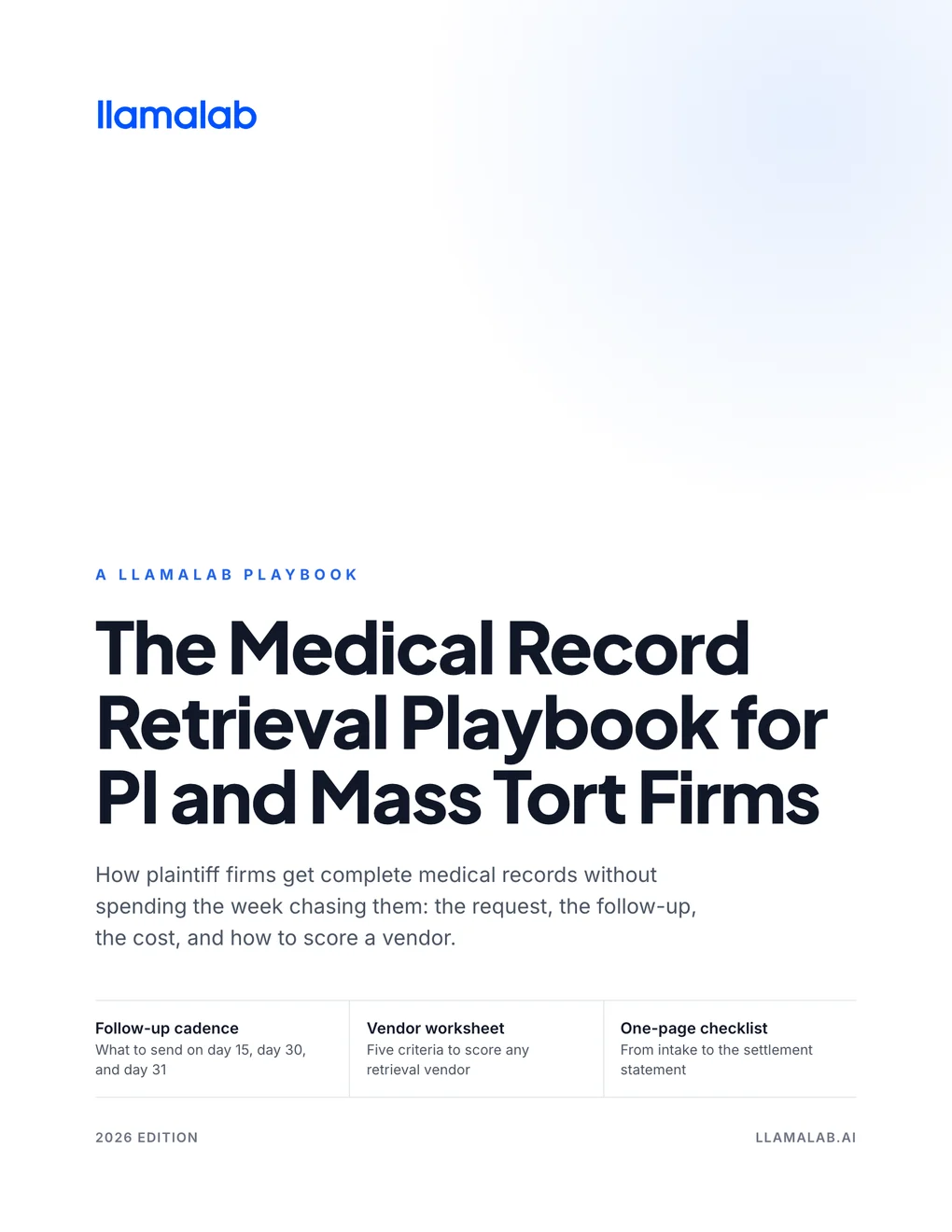
Building Bard hernia mesh files?
Get the steps for finding every treating provider, the follow-up cadence, and a one-page retrieval checklist.
Build Settlement-Ready Hernia Mesh Case Files
LlamaLab retrieves records across multi-year treatment histories in 4 days on average, with reverse search to find forgotten providers and itemized per-case billing for disbursement recovery.
This article is for informational purposes only and does not constitute legal advice.
Sources: Insurance Journal (Bloomberg): BD Hernia-Mesh Settlements Will Exceed $1 Billion (Oct. 4, 2024), JPML: Pending MDL Dockets by Actions Pending (Sept. 1, 2026), BD Form 10-Q for the quarter ended June 30, 2026, BD Form 10-K for fiscal 2025, BD Form 10-K for fiscal 2024, BD Form 10-Q for the quarter ended June 30, 2024, S.D. Ohio MDL 2846: CMO 52, Stay Order, CMO 53, Docket Control Order, CMO 55, Special Masters and Intensive Settlement Process, CMO 56, Qualified Settlement Fund, CMO 58, Common Benefit Payments, Miller & Zois (plaintiff law firm), Hernia Mesh Case Value, Journal of the American College of Surgeons via PubMed, Insurance Journal (Reuters): Covidien verdict (Aug. 5, 2026).
Stay Updated with Latest Insights
Get the latest articles about medical record retrieval and legal tech delivered to your inbox.