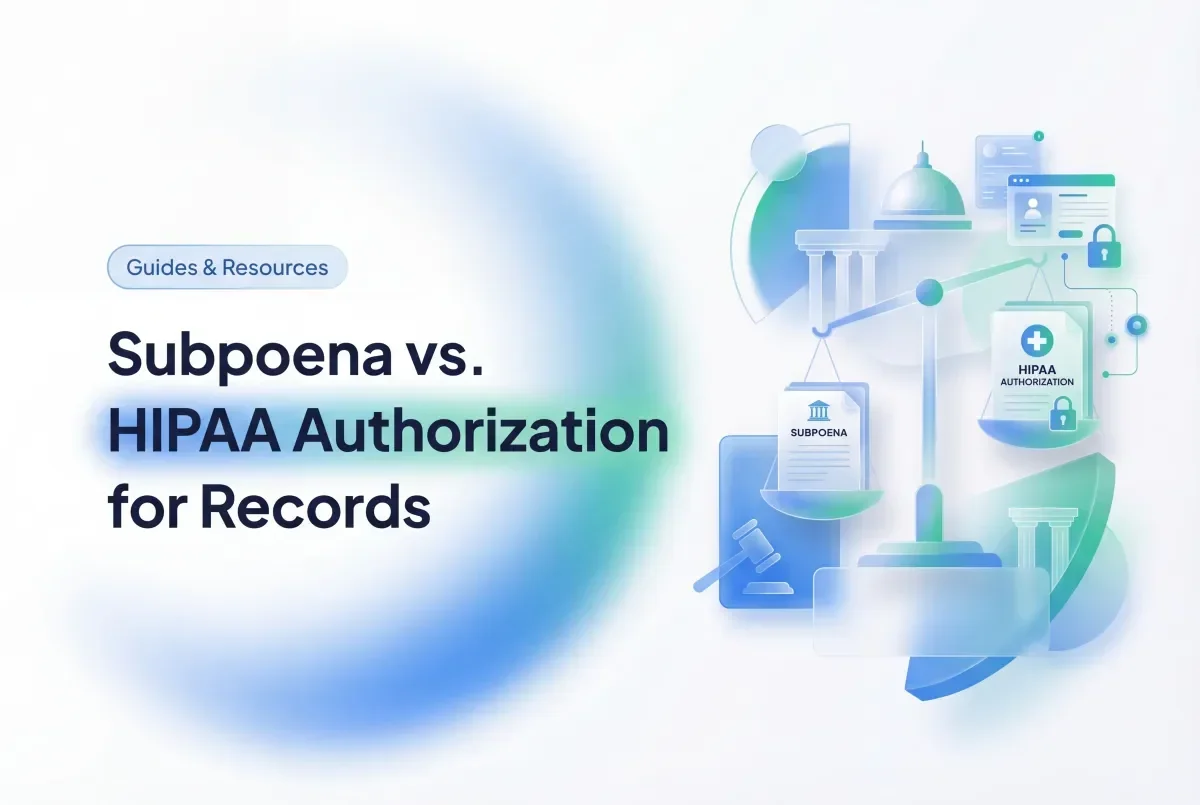
Subpoena Medical Records vs. HIPAA Authorization

Head of Customer Success at LlamaLab
Subpoena Medical Records or Use a HIPAA Authorization? A Guide for Attorneys
Choosing the wrong method for obtaining medical records can cost a case weeks of delay. A HIPAA authorization averages 30-45 days for provider response, while a subpoena typically compels production in 7-14 days. For attorneys managing active litigation, that gap can mean the difference between meeting a discovery deadline and filing for an extension.
Providers are also more careful about what they release. The updated 42 CFR Part 2 rule became enforceable on February 16, 2026, when HHS's Office for Civil Rights began accepting complaints and breach reports for substance use disorder records, and OCR resolved 21 HIPAA cases with financial penalties in 2025. Getting the method wrong does not just slow a case down. It can trigger compliance violations for the provider and leave key evidence out of reach.
Average HIPAA authorization turnaround time
Typical subpoena response timeline
OCR HIPAA cases resolved with financial penalties in 2025
HIPAA Authorization for Attorneys: 45 CFR 164.508
A HIPAA authorization is a signed document in which the patient voluntarily consents to the release of protected health information. It is governed by 45 CFR 164.508 and is the standard method when an attorney needs records from a cooperative provider on behalf of their own client.
The process is straightforward in theory. The patient signs, the attorney sends the form to the provider, and the provider responds. In practice, turnaround averages 30-45 days because most providers batch-process authorization requests alongside hundreds of others. Some large health systems take even longer.
Authorizations work best in pre-litigation, when discovery has not yet begun and no adversarial dynamic exists with the provider. They also avoid the procedural overhead of a subpoena, since there is no need for patient notification or a qualified protective order.
Six Required Elements of a Valid HIPAA Authorization
One critical detail: the Privacy Rule prohibits providers from conditioning treatment on signing an authorization. An authorization that bundles consent for treatment with consent for disclosure is invalid on its face.
How to Subpoena Medical Records Under HIPAA: 45 CFR 164.512(e)
A subpoena is a legal instrument that compels a provider to produce records, governed under 45 CFR 164.512(e). Unlike an authorization, it does not require the patient's signature. It requires legal process.
Before a covered entity can release records in response to a subpoena, it must receive what HIPAA calls "satisfactory assurances" from the requesting party. That means one of two things: proof that the patient received adequate notice and did not object within the allowed period, or a qualified protective order that restricts how the records can be used.
A qualified protective order prohibits the parties from using PHI for any purpose other than the litigation at hand and requires its return or destruction at the end of the case. Attorneys can either negotiate one with opposing counsel or petition the court directly.
Subpoenas are faster. State subpoenas typically allow 7-14 days for response, and providers treat them with more urgency than authorization requests. But the procedural requirements are stricter. A subpoena missing proper patient notice can be quashed, leaving the requesting attorney back at square one.
When to Use Each Method
The decision is not always obvious. Here is how the two approaches compare across common litigation scenarios.
When to Use Authorization vs. Subpoena
HIPAA Authorization
Own Client's Records
Authorization is the standard path for your client's treatment history
Pre-Litigation Phase
No formal discovery needed, authorization is sufficient
Cooperative Provider
Provider responds to requests without legal compulsion
Part 2 SUD Records (With Consent)
Patient willing to authorize substance use disorder records
Subpoena
Opposing Party Records
Subpoena is the only viable path for adverse party records
Non-Responsive Provider
Provider ignoring authorization requests responds to legal compulsion
Expedited Timeline Needed
7-14 day subpoena response vs. 30-45 day authorization wait
Third-Party or Discovery Records
Records from non-treating providers or during active discovery
One scenario needs more than either method alone: 42 CFR Part 2 substance use disorder records of a patient who has not given written Part 2 consent need a court order in addition to the subpoena. Under 42 CFR 2.61, the Part 2 court order authorizes the disclosure and the subpoena compels it. A subpoena without the order does not permit the program to release the records.
Common Mistakes That Get Requests Rejected
Providers reject record requests more often than most attorneys realize. According to Holland & Hart's HIPAA analysis, "most of the authorizations attorneys see do not contain the required elements and are, therefore, invalid." The following errors account for the majority of rejections.
1. Overly Broad Authorizations. Requesting "any and all records" or "the entire medical record" invites objections. HIPAA requires a specific and meaningful description of the information to be disclosed. "Office visit notes from January 2024 through March 2025" passes. "All records" often does not.
2. Missing Required Elements. The six core elements under 45 CFR 164.508 are non-negotiable. The most commonly omitted: expiration date, revocation rights statement, and redisclosure notice. Any one missing element renders the authorization invalid.
3. No Patient Notice on Subpoenas. Under 45 CFR 164.512(e), the requesting party must demonstrate that the patient was notified and given time to object. Skipping this step gives the provider legal grounds to refuse production entirely.
4. Using Attorney-Drafted Forms. Many attorneys send their own authorization forms with subpoenas. The problem: attorney-drafted forms frequently omit HIPAA-compliant elements. Providers prefer, and sometimes insist on, their own forms.
5. Incomplete or Outdated Patient Information. Wrong name spellings, outdated addresses, or inverted date-of-birth fields cause providers to reject requests as unverifiable. This is especially common in mass tort cases where intake data may not be fully validated.
6. State-Specific Procedural Errors. California requires a Notice to Consumer with a 15-day objection period. Missing it invalidates the subpoena. New York requires requesters to qualify under Public Health Law Section 18. Each state adds its own layer of requirements on top of federal HIPAA rules.
Whether a firm handles requests in-house or through a retrieval partner, these six errors are the ones to audit first.
How LlamaLab Eliminates the Wait
The timelines above assume a firm is submitting requests manually, one provider at a time, and waiting for each to respond. LlamaLab's retrieval process works differently.
Records come back in 4 days on average, and 30 to 40% come back the same day. That is not a replacement for subpoenas, which remain the right tool when legal compulsion is required. But for authorization-based retrieval, the 30-45 day industry average does not have to be the default.
The speed comes from three things working together.
Provider Intelligence Engine
A continuously updated database built from years of high-volume retrieval across millions of providers. Identifies the exact department, correct contact method, and optimal routing for each facility based on historical response patterns.
- Right department, right form, right channel for every facility
- Routing optimized by historical response data
- Direct integrations with health data networks and clinical groups
Reverse Provider Search
Uses insurance data to fill in treatment gaps clients don't always remember, surfacing facilities, dates, and clinicians as needed before defense discovery.
- Reverse search finds providers clients forget
- Discovers unlisted facilities and clinicians
- Fewer gaps in medical evidence, fewer follow-ups
Automated Compliance & Submission
AI validates every authorization for the six required HIPAA elements before submission, routes to the correct provider contact, and sends automatically with delivery confirmation.
- Pre-submission HIPAA compliance validation
- Automatic follow-ups and escalations
- 30 to 40% of records returned the same day
For firms handling personal injury or mass tort caseloads, the combination of accurate provider targeting, compliant submissions, and network access compresses what used to take weeks into days.
State Variations to Know
HIPAA sets a federal floor, not a ceiling. When state law provides greater privacy protections, state law controls. Four states stand out for practitioners handling multi-jurisdiction cases.
California layers the Confidentiality of Medical Information Act (CMIA) on top of HIPAA. Subpoenas for medical records require a Notice to Consumer and a 15-day window for the patient to object. California also requires an Evidence Code Section 1561 declaration from the records custodian.
New York restricts who can request records. Under Public Health Law Section 18, a requester must qualify as a "qualified person," and additional protections apply to mental health records under the Mental Hygiene Law.
Florida is more permissive. Under Florida law, medical records may be furnished without written authorization when a court issues a subpoena to a party in a lawsuit requiring them to provide their records. This simplifies the process compared to most other states.
Texas has enacted stricter healthcare privacy safeguards beyond federal requirements, including comprehensive AI-related laws affecting how health data is processed and disclosed.
The Part 2/HIPAA alignment rule adds another dimension. Since February 16, 2026, HIPAA covered entities and business associates that receive Part 2 records under a patient's single consent for treatment, payment, and health care operations may redisclose them under HIPAA rules. That permission does not extend to civil, criminal, administrative, or legislative proceedings against the patient, which still require specific patient consent or a court order. HIPAA Notices of Privacy Practices had to be updated by the same date. Firms requesting SUD records for litigation should plan for a Part 2 court order or a separate litigation consent rather than assuming standard HIPAA disclosure applies.
What This Means for 2026
Key Points
Essential takeaways from this article
OCR's enforcement priorities for 2026 are summarized in HIPAA Journal's enforcement tracker, the Part 2 program is described in the HHS announcement of February 13, 2026, and the status of the reproductive health rule is posted on HHS's reproductive health page. Compliance requirements are increasing from both federal and state directions. Firms that treat record retrieval as a purely administrative task risk delays, rejections, and regulatory exposure. Those that build compliance into every request, whether through internal protocols or retrieval partners like LlamaLab, will avoid the most common pitfalls.
The Bottom Line
Authorization and subpoena are not interchangeable tools. Authorization is the right choice for a cooperative provider releasing a client's own records in pre-litigation. Subpoena is the right choice when speed matters, when the provider is non-responsive, or when the records belong to an opposing party.
The cost of choosing wrong is measured in weeks. Getting it right starts with knowing which federal and state rules apply, including the six required HIPAA authorization elements and the satisfactory assurance requirements for subpoenas. Building compliance into the request process from the start with an AI-native medical record retrieval service for lawyers is the only reliable way to keep cases moving without regulatory bottlenecks.
Choosing between authorization and subpoena?
Get the playbook chapter on what gets requests rejected, the day 15, 30, and 31 follow-up steps, and a printable checklist.
Medical Record Retrieval for Lawyers
Records come back in 4 days on average, and 30 to 40% come back the same day. AI-powered compliance checks and provider discovery on every request.
Sources: 45 CFR 164.508, 45 CFR 164.512, HHS.gov Court Orders and Subpoenas, HHS.gov Authorizations FAQ, HHS.gov Part 2, HHS Part 2 Final Rule Fact Sheet (updated January 30, 2026), HHS OCR Part 2 Civil Enforcement Program (February 13, 2026), 42 CFR 2.61, HHS.gov HIPAA and Reproductive Health, Holland & Hart HIPAA Checklist, HIPAA Journal HIPAA Violation Cases, HIPAA Journal, MedSafe HIPAA Enforcement 2025, California Civil Code Section 56.10.
Stay Updated with Latest Insights
Get the latest articles about medical record retrieval and legal tech delivered to your inbox.